| |
From the catalogue
personal exhibition – Gallery “8,75” – Reggio
nell'Emilia (Italy).
 The annals of Tibetan wisdom recount that a monk named Lao Tseu one day
stopped in petrified bewilderment in front of his fellow Song's vibrating
and lithe sculptures and let slip this praising remark: “Brother
Song rather than devoting himself to the creation of forms mostly worries
about the air around them”. Franco Pizzi, an artist from Piacenza,
graduated at “Paolo Toschi” Institute of Parma, does the some.
The annals of Tibetan wisdom recount that a monk named Lao Tseu one day
stopped in petrified bewilderment in front of his fellow Song's vibrating
and lithe sculptures and let slip this praising remark: “Brother
Song rather than devoting himself to the creation of forms mostly worries
about the air around them”. Franco Pizzi, an artist from Piacenza,
graduated at “Paolo Toschi” Institute of Parma, does the some.
This seems atypical, seen that traditional sculpture strived to capture
space, to engulf the air and remodel turough the ductility of forms, the
solidity of expanding volumes and the heaviness of a matter that, althought
it is rended light the breath of art, it is is firmly rooted 'in the eart'
and has its retribution from void, that is to say from nothing................
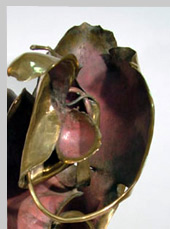
On the contrary, Franco Pizzi's flowers, animals and people float with
"their heads in the clouds": not only because of the dreamy sweetness
of some of is paintings (il contatto) whose subjects seem lost in a private
tale, but mostly thanks to the fact that they aim at flying up, and do
it. When they float, defying gravity that links them to the earth, their
material, bronze or terracotta, melted by the contact with the atmosphere,
crumble and draw up air and light, opens up into fan-shaped from which
doesn't kill the volume of forms bat the contrary it expands and inflates
it letting it free to fluctuate like a breeze..................This is
why,instead of structures solidly carved in space by chisel we have sculptures
that seem painted in it wich an expressionistic and informal touch.
Some of his polymorphous shapes and twisted laminaes evoke Leoncillo's
turgid forms. 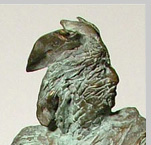 Some of his flowers remind us of the organic-like
volutes of Ans Arp. He means no dramatic tone or polemic intent: he has
an unconscious regard for late-Romanticism and its lyric languors and
for an utopian idea of society which finds his champion in Medardo Rosso,
and a modern sympathizer in Franco Pizzi........... Some of his flowers remind us of the organic-like
volutes of Ans Arp. He means no dramatic tone or polemic intent: he has
an unconscious regard for late-Romanticism and its lyric languors and
for an utopian idea of society which finds his champion in Medardo Rosso,
and a modern sympathizer in Franco Pizzi...........
Pizzi doesn't aspire to capture eternity, or, more to the point: he prefers
to eternalize an istant, the flash of an expression, a movement, a throb
of life right before their disappearing. He knows that this is the only
certitude we have.
 Back to top
MILENA MILANI
Art, a neverending gift.
By
the paper “Il gazzettino di Venezia” (1991) – personal
exhibition at Cortina d'Ampezzo.
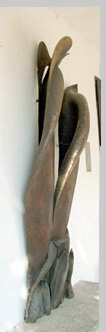
 ..........I sometimes thought that flowers, in their sublime shapes might
grow, get bigger, become sculptures, monuments. Everything had already
been invented, it existed on earth, in the sunlight. You only had to be
able to look, absorb those contents, those lines, so new, elegant, sensitive
and the “flower-sculptures” would have a long life for everybody's joy.
..........I sometimes thought that flowers, in their sublime shapes might
grow, get bigger, become sculptures, monuments. Everything had already
been invented, it existed on earth, in the sunlight. You only had to be
able to look, absorb those contents, those lines, so new, elegant, sensitive
and the “flower-sculptures” would have a long life for everybody's joy.
 In
the shade of stamen and pistils of the heavenly stems, of sweet calyxes,
I would be peaceful because I had found my shelter, that blossomed and
steady oasis that would have no ending, no decay. The sculptor Franco
Pizzi, a visionary artist, has made my desire his own and he has fulfilled
it without my knowing it and now with his “wax model to lose” fusions
he offers to me and to everybody his golden bronze sculptures, unique
examples that have the lightness of real flowers, of dreams with unusual
names: water lily, periwinkle, edelweis,lily of the valley, poppy, sunflower............
il complesso degli organi di riproduzione delle piante Fanciful words,
sweet syllables that I say spellbound, because I remember what my father
used to say and also the painter Filippo de Pisis who knew Latin and had
the right name for every flower, never making any mistakes. De Pisis after
used to paint flowers, once he painted a watercolour for me with some
zinnias in a glass; he gave it to me in Venice as we were in his studio
at San Barnaba. Flowers have got many powers and the “flower-sculptures”
double them, They make them hundreds. In Cortina d'Ampezzo where double
them, They make them hundreds.Franco Pizzi displays his works there is
this vague mistery of sexuality. The flowers are the reproduction organs
of the phanerogam plants, different male fimale organs, hidden inside,
but also showns, visible tender and proud at the same time; In
the shade of stamen and pistils of the heavenly stems, of sweet calyxes,
I would be peaceful because I had found my shelter, that blossomed and
steady oasis that would have no ending, no decay. The sculptor Franco
Pizzi, a visionary artist, has made my desire his own and he has fulfilled
it without my knowing it and now with his “wax model to lose” fusions
he offers to me and to everybody his golden bronze sculptures, unique
examples that have the lightness of real flowers, of dreams with unusual
names: water lily, periwinkle, edelweis,lily of the valley, poppy, sunflower............
il complesso degli organi di riproduzione delle piante Fanciful words,
sweet syllables that I say spellbound, because I remember what my father
used to say and also the painter Filippo de Pisis who knew Latin and had
the right name for every flower, never making any mistakes. De Pisis after
used to paint flowers, once he painted a watercolour for me with some
zinnias in a glass; he gave it to me in Venice as we were in his studio
at San Barnaba. Flowers have got many powers and the “flower-sculptures”
double them, They make them hundreds. In Cortina d'Ampezzo where double
them, They make them hundreds.Franco Pizzi displays his works there is
this vague mistery of sexuality. The flowers are the reproduction organs
of the phanerogam plants, different male fimale organs, hidden inside,
but also showns, visible tender and proud at the same time;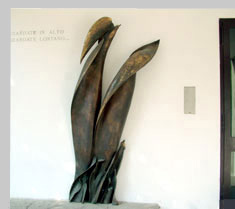 the heart of life, the flash of poetry and imagination. Franco Pizzi has
spiritualized them as if they had a musical halo, a persistent thrill
of notes something that detached from structures to comunicate with the
supernatural world. Rapture? Or burning fire, we don't ask for any explanations,
I too accept what I see, because we don't know how transformations take
place, through inscrutable roads. The roads of art, a nervering gift.
the heart of life, the flash of poetry and imagination. Franco Pizzi has
spiritualized them as if they had a musical halo, a persistent thrill
of notes something that detached from structures to comunicate with the
supernatural world. Rapture? Or burning fire, we don't ask for any explanations,
I too accept what I see, because we don't know how transformations take
place, through inscrutable roads. The roads of art, a nervering gift.
Cortina d'Ampezzo, november 29 1991
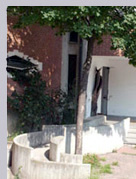
Photo – "Ragazzi del Brentei" Monument (Piacenza).
back to top
|
|


